
Travis Picking Techniques Revealed
 Merle Travis was an innovator. He created one of the most effective finger picking techniques on guitar. But knowing this doesn’t teach you anything, does it?
Today we will discuss the basics of Travis picking, from preparation to technique. Before we start anything though, it is important that you look at your strings. If they are rusty and frail, it is best you change them before finger picking. Old rusty strings can cut into your fingers, which not only leaves a chance for tetanus but will also set you back from fingerpicking for at least a week.
While you don’t need to change strings each and every time you finger pick, it is best that you wipe your strings down after each use and wash your hands before playing. At the first sign of rust, be sure to change your strings.
The State And Conditions of Your Fingernails Matter
Now that you have nice fresh strings, we can begin our lesson. First, you will need to decide whether you want long nails or short. Long nails are great for Travis picking when they are strong, but keep in mind that nail breaks are extremely nasty and painful. If you choose the finger route, you should build up the callus before learning most of these techniques.
Sensitive finger tips will affect form as you will unknowingly sacrifice proper technique to avoid pain. Each day for two weeks, practice a basic forefinger to middle finger to ring finger strumming pattern to help build your callus up.
Once your fingers are worn and ready, we can discuss some of the insights of Travis’s picking techniques.
First Up is Pinching
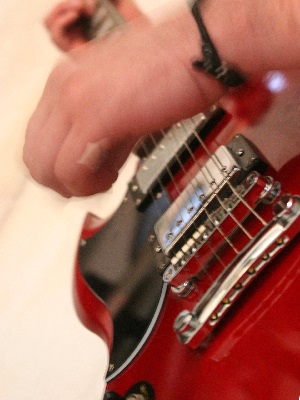 Pinching is achieved by playing two notes simultaneously, one high and one low. The low note is to be gripped with your thumb. The high note will be gripped in your middle finger. At the same time, pull both fingers off of the notes and towards one another.
Allow them to ring to their full value. The strings may bounce a bit, but that is alright; that is part of the pinching technique. The key to pinching is to actually pinch the notes towards each other before releasing them. This achieves a twang which is a trademark of the Travis picking technique.
Next Up is the Alternating Bass Note
This technique is fairly simple, but it can also take a lot of time to learn. The alternating bass note does exactly as it claims, as well; it alternates between each note. This is achieved by alternating the strumming of your thumb and fingers. The best way to achieve a proper alternating bass note is to use a metronome.
Not only will the metronome help you to develop your sense of rhythm more accurately, it will also help you to achieve fluidity. It is important that you alternate not only the note but your fingers as well. Your thumb is always designated as the bass note digit, but to help yourself develop independence, alternate between your forefinger, middle finger, and ring finger.
Now that you know the techniques of Travis picking, it’s time to practice. Set aside a block of time each day to practice your technique along with a metronome. When practicing, don’t watch television; focus on your instrument and your form. Have fun!
Get Inspired By Awesome Guitar Instructors Today!

GuitarTricks.com is an online guitar learning website that offers lessons that are easy to understand and use. With more than 4,000 video guitar lessons, you are personally coached by more than 45 different instructors!
Try Guitar Tricks with a 14-days free trial now!
Related Articles



We Recommend…

Leave A Comment
One Comment
I enjoyed your teaching.
i quite playing 10 years ago and want to start back playing fingerpicking.My goal is to learn to play windy and warm.Im 63 and dont want to waist any time playing.Also I have been looking for a music store that sells Fred Kelly picks.I live in Cleveland,Ga. about 3 miles from Helen,you should know where that is.
I want to learn the 3 base and melody instead of alternating between 2 base notes.Do you have tabs on this?
Thanks so much,Clifford,My number is 706-809-2457 if you care to call.