
Everything You Need to Know About Natural Minor Scales
 In the previous lesson, we covered the major scales extensively across the entire guitar fretboard. Today’s lesson will focus on another fundamental scale that’s commonly used in music: the minor scale.
Unlike the happy sounding feel of the major keys, music played in minor keys gives a completely different feel. They tend to sound solemn, sad, dark and ominous. That’s the reason why many of the “love” songs are written in the minor keys.
What Are The Types Of Minor Scales?
In music, there are 3 main types of minor scales: natural minor, melodic minor, and harmonic minor. In this lesson, we will only focus on the natural minor scale first. I will cover both melodic and harmonic minor scales in later lessons once you have the proper foundation knowledge.
Like the major scale, the minor scale can be constructed from scratch by applying the following formula, WHWWHWW (W = Whole tone and H = Half/Semi-tone). When you compare this set of intervals against that used in deriving the major scale, do you notice any differences?
Let’s use the A minor scale as an example in this guitar lesson. By applying the interval formula, we get:
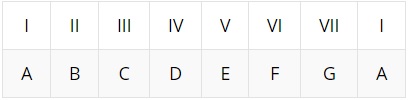
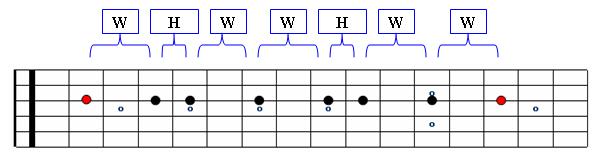
If you are observant, you might have realized the A natural minor scale contains the same exact notes as the C major scale. In fact, they share the same key signature and this is why A minor is known as the relative minor of the C major scale.
Minor Scale Exercise – Let’s Start Playing
In this exercise, I want you to pay attention to the sound differences between the C major scale and C minor scale. If you need a quick refresher on major scales, feel free to refer to the previous lesson for more details.

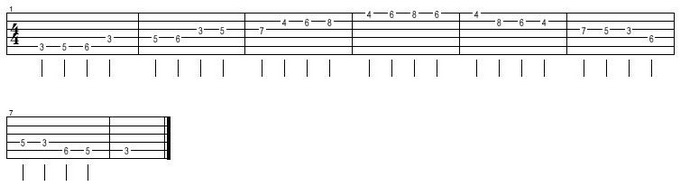 Download .gtp5 or .mp3 file ( Right-click Save Target as… )
Now, I want you to spend some time learning up and memorizing the formula for minor scale construction. Also, are you able to pick up the differences between the C major and C minor scales? Leave a comment below and let me know!
To illustrate this using G major, if you go down 3 semitones from the G note, you would get an E. Thus, the relative minor of G major is E minor.
Jamplay – Awesome Teachers, Excellent Video instruction And Community

Jamplay is the LEADING online guitar lesson website that offers step-by-step videos in high-definition. They cover EVERY genre of guitar style and have comprehensive content for guitar players of any skill level.
Jamplay also showcases a continuously growing archive of instructional videos that’s updated weekly. What’s even better, they also offer indepth tutorials for members to learn popular songs with the help of precise, dynamic tabs and song demonstrations.
p.s: We’ve arranged a special deal our readers. Get your exclusive Jamplay promotion code here…
Related Articles



We Recommend…

Leave A Comment