
Guitar Chord Inversions And Voicings
 Do you always get stuck in a rut when playing rhythm guitar where you keep strumming the same old chords over and over again? Perhaps, the open chords or standard major/minor barre chords are all that you know about playing the rhythm guitar.
To be honest, that’s how I was during my first 2 years of playing the guitar. The standard guitar chords (found in most chord books) were all that I knew because they were sufficient for me to get by with learning songs. Basically, I got comfortable and never bothered to experiment with new stuff.
It was only when I started listening to Japanese rock music that I came across guitar chord inversions and their utility. Famous J-Rock bands such as L’arc en Ciel often incorporate chord inversion into their songs which help defines their unique signature sounds. On top of that, inversions add more depth to their music and helped them to avoid sounding monotonous.
So, what are inversions? They basically refer to triads whereby the lowest note (bass note) is NOT the root note of the chord. When naming them, the most common chord inversions are often referred to as the first inversion, second inversion and third inversion respectively.
Let me use a Cmaj7 chord as an example to illustrate this. In the Cmaj7 chord, we have the following notes: C E G B.
What Are the Chord Inversions of Cmaj7?
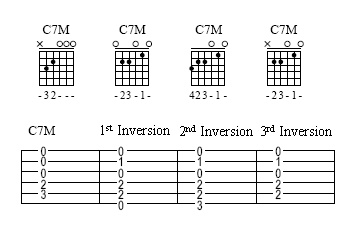
The first inversion is played using the third as the bass note. (i.e. Using E for the bass note)
The second inversion is played using the fifth as the bass note. (i.e. using G for the bass note)
The third inversion is played using the seventh as the bass note. (i.e. using B for the bass note)
In a nutshell, you can create your own inversions by jumbling up the order of the notes in the chord. Just keep in mind that the lowest note of the chord shouldn’t be the root note.
How to Use Chord Inversions In Your Playing
The technique of playing chord inversions is a powerful tool to add to your arsenal because the possibilities are endless. You can experiment and come up with creative voicings by using them at the correct time. Here are some tips on how you can apply them to your playing.
For a start, if someone is playing a C G Am F progression, you could add in a layer of harmony by using the following inverted chords:
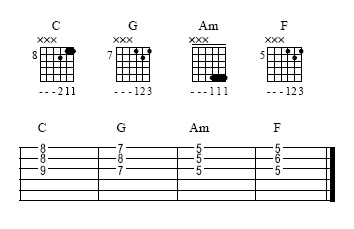
Of course, you should also try different notes and combinations to hear for yourself how they would sound in real life. Now, if you are the only rhythm guitar player around, it is not advisable to start playing inverted chords at the higher range of the fretboard. In such circumstances, you would probably be better off playing open/barre chords to achieve a fuller sound.
In music phrases, you might find it easier to inject chord inversions toward the middle portions of the song. I personally find that the standard chords should be used in the beginning and the end of musical phrases in order to maintain stability and resolve the piece of music.
Lastly, I want you to experiment with inversions and let me know about your experiences with them. Are they useful in your playing? Did you come up with any awesome tones? Do leave a comment below!
The Ultimate Guitar Learning Guide

Related Articles


We Recommend…

Leave A Comment