
Riffs And Rhythms in Drop D Tuning
 Whether you are tired of power chords or you just want a lower note to give your music more of a growl, drop D tuning is a great tuning for modern heavy metal.
With dropped tuning, you can bar your chords and create larger chord shapes without added effort. This makes for bigger sounds and more depth within your music.
Tons of bands have played in drop D as well, such as Deftones on their album Around the Fur, and heavy metal powerhouse Lamb of God on almost all of their albums.
The first thing we will demonstrate is some ways in which you can make huge chord sounds using either the open strings (dropped tuning makes a whole new set of possibilities in this department) or barred chords.
The Dissonant Chord Progression
This style of progression is using the open D string to add that depressive, longing feeling.
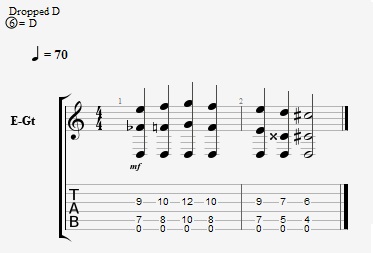
Download the .gtp file for the lesson ( Right click and Save As… )
Notice the time signature, as this piece isn’t meant to be fast. The slow meandering feel adds to the aura of the octaves being played, giving them that desperate quality.
Playing Barred Chord Progressions With Dropped Tunings
This is also another depressive melody that I use just to display the power that dropped tuning can have.
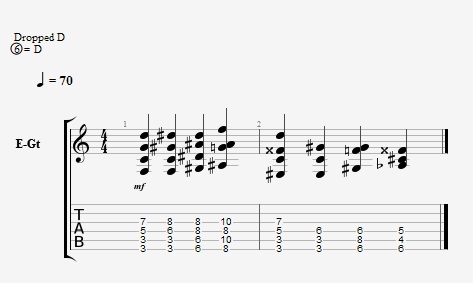
Download the .gtp file for the lesson ( Right click and Save As… )
Like the first piece, this piece is to be played slowly. Note the chord shapes. If you were to try and play these chords in standard tuning, it would be nearly impossible due to the distance there would be between notes.
Doing It On Your Own
When you have learned these chord shapes, try making your own. Note that you can now play a power chord by simply laying your finger across the lower three strings on any fret. This means that extending your power chords and turning them into whole new voices is almost made easy.
This is one of the greatest aspects of dropped tuning, as most chords you know can be expanded upon easily, as the low D string and the A string are a perfect fifth apart now. This is what makes dropped tuning so great for faster playing; no need to prepare your fingers, just bar.
Simplified Playing Methods For Difficult Sounding Passages
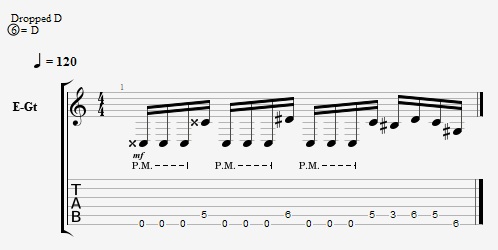
Download the .gtp file for the lesson ( Right click and Save As… )
Next up are a few examples of basic guitar riffs which take full advantage of the lower D string. Notice how easy it makes single enunciated note riffing.
This is a typical riff that you would hear from a band such as Lamb of God. The palm meets in between notes lend accents to the single notes, and the run at the end ties the rhythm together nicely.
It is great to write guitar riffs like these, but try not to fall into a pattern. I have seen many great musicians get comfortable using this style, and after a while it all begins to meld together.
Try using the dropped tuning to enunciate different notes, or try different patterns. If you find yourself using a lot of chugging, make a mental note to stay away from the style for a bit of time.
Dropped D tuning has a variety of benefits and can be used in numerous ways to note only expand your chords but to add a new element to your music. Now that you know a few ways to utilize the dropped string, practice hard and experiment with your own ways of using it.
Revolutionize The Way You Play And Learn Music

Guitar Pro 6 is a powerful tablature editor software for guitar, bass, and other fretted instruments. Equipped with a realistic audio engine, it makes writing music, guitar playing and learning songs a walk in the park. Click here to download Guitar Pro 6 instantly now…
Related Articles


We Recommend…

Leave A Comment