
How to Spice Up Guitar Chords And Sound Like A Pro
This is a continuation of the article explaining how to get to using complex chord voicing through mere practice. In the past article, I explained how I look at chord progressions and melody lines.
If you had missed the earlier article, you can view Make Guitar Chords Sound Interesting. Now we’re going a bit deep into that subject.
Let’s take C, Am, Em, Em chord progression, and let’s play it finger-style of some sort. Pick bass (lowest) notes with your thumb and other notes with the other 4 fingers of your right hand.
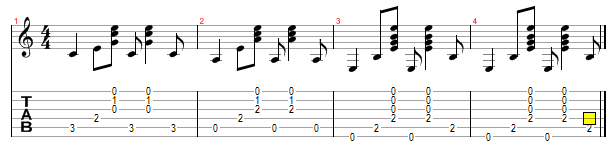
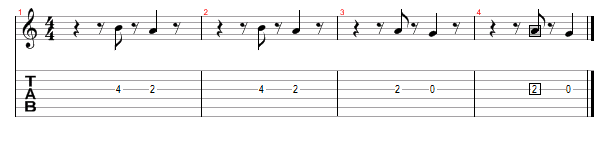
Now, our focus will be on the 3rd melody line (or, melody line on 3rd string). In this moment it looks like this:

Let’s change it to this:
 Now, let’s bring all the other notes back:
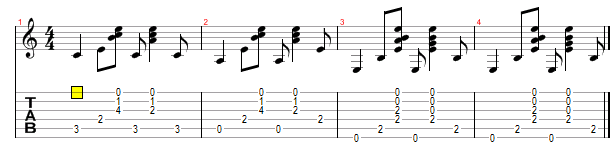 We got lots of new chords, without even knowing! And that’s the sole purpose of this view on chord progressions; to make more interesting chords in chord progressions without having to initially memorize all the chords that can be used in those progressions. Of course, it is very useful to learn those chords afterward. I will explain the new 4 chords we got:
C7M (no5)
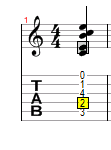 This is C major chord that has major 7th instead of perfect 5th (which would be open G string), and it has (no5) mark, because it obviously lacks perfect 5th, which all basic major and minor chords have. It sounds dreamy and positive.
C6 (no5)
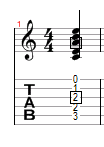 Again, this is C major chord with major 6th instead of perfect 5th. This chord can be also looked at as Am chord with C in bass (Am/C), but in this case, it is C6 (no5). This one carries an optimistic and positive vibe to it, with an unresolved statement, because of major 6th.
Amadd9
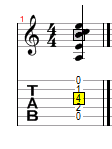
This is Am chord with added 9th (B note on 3rd string) instead of an octave. This one is pretty common in sad songs.
Esus4
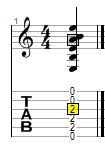 Sus chords on guitar generally don’t have a 3rd which would define if the chord’s major or minor, so it’s simply suspended 4th (4th on higher octave) instead of major or minor 3rd. This one just waits for some kind of resolution, which can be done by playing standard E or Em afterwards.
Ok, now, let’s get back to our chord progression. Let’s change 2nd melody line (on 2nd string) now. It looks like this originally:
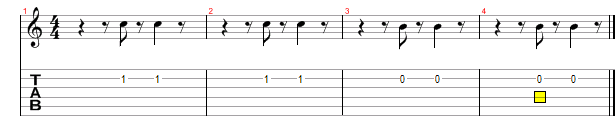 Let’s change it to this:
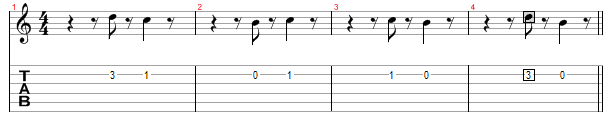 If we add up all the other notes, we’ll get this:
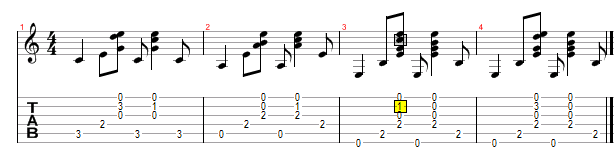
More new chords! It’s advisable to always write out all the new chords, and how they sound individually.
Cadd9
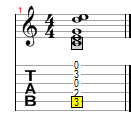
This is simple C major with added 9th (D note on 2nd string) instead of an octave. That 9th makes the chord more calming, but the chord is quite stable – it doesn’t ask for resolution, but you can always resolve the 9th on the octave.
Asus2
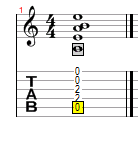 Though this may seem to you like Aadd9 chord, it’s not, because it doesn’t have the 3rd. B note represents 2nd as well as 9th, so now, this is suspended 2nd. Try resolving B note on 2nd string to C, or C# note on 2nd string, and you’ll hear the nature of sus chord.
Emadd13-
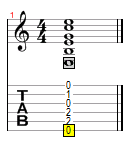 This is Em chord with added minor 13th (or minor 6th on higher octave).
Em7
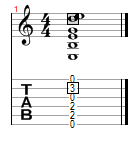 This is Em chord with minor 7th. 7th are often found in chords in blues and funk.
Now, let’s try to combine melody line changes of our chord progression. Let’s alter 1st and 2nd melody lines simultaneously. Originally, they look like this:
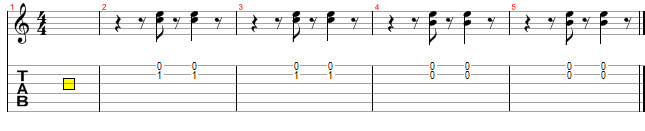 Now they look like this:
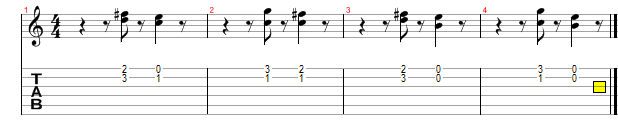 So, new outfit of our chord progression looks like this now:
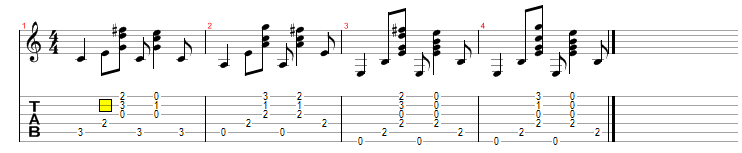 Now, we got some pretty cool chords here:
Cadd9(#11)
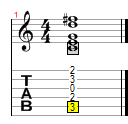 This chord is C major with added 9th (D note on 2nd string) and sharp 11th (F# note on 1st string) (sharp 4th on higher octave). That sharp 4th is the signature of the Lydian mode. Try resolving it to G note. Its ambiance is amazing. Pure dream.
Am7
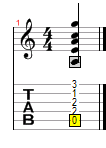 This is Am with added minor 7th on a higher octave (G note on 1st string).
Am6
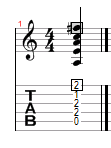 This is Am with added major 6th on higher octave (F# note on 1st string).
Em7add9
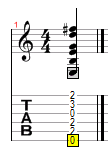 This is Em chord with minor 7th (D note on 2nd string) and added 9th (F# note on 1st string).
Emadd9(b6)
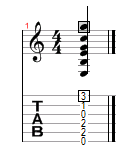 This is Em chord with added 9th (F# on 1st string) and flat 6th (C on 2nd string). Try playing this progression: Em7add9, Emadd9(b6) and then Em. You will clearly see how each of those melody lines resolves each other.
I leave it up to you to realize which way works better for you – learning guitar chords and how they work in each progression, and then implementing them, or changing the melody lines and having them in your ears, meaning that you can hear their change before you actually do it. For me, the second way is much easier to work with than the first, but the best thing for me, which I realized, is to combine both of them. You just have to be fully into what you’re playing.
Looking For Step-By-Step Video Guitar Lessons?
Trusted by 200,000+ students, Jamorama is the leading provider of guitar courses. If you are looking for a fun way to learn the guitar and want to play-along with your favorite songs, check out Jamorama today…

Related Articles



We Recommend…

Leave A Comment