
Secrets to Making Your Guitar Chords Sound Interesting
 This article explains how I began to use more complex and harmonious chords, instead of simple major and minor chords. Actually, when I first started doing this, I had no thought on music theory behind most of those chords, nor their names (though, through time I learned them).
I only focused on how they sounded, and what tones fit in each chord. I easily got it into my ears, which changes I can make on chords, for them to sound more exotic while not changing their function or nature.
Ways Of Applying Complex Chords
I believe there are 2 ways of learning how to implement complex chords. One is to know all the chords in theory and have them memorized, as well as their function in each chord progression you choose to play in. This way requires very big knowledge initially before you can even start combining those types of chords.
The other way is to take all the easy guitar chords you have in your chord progressions and change their intervals one by one, while noticing and memorizing the difference. This is what I talk about. I see chord progressions as multiple melody lines (directed intervals), played at same time. Take a look at this to understand me more clearly:

This diagram explains the transition from Em to F chord. I see that transition, not only as 2 separate groups of notes (chords), but as 6 synchronized melody lines. The numbers to the left say that E to F is 1st melody line, B to C is 2nd, and so on.
Now, if I want to spice up the Em chord in this progression, I will probably start by replacing or adding one or more of the first five beginning melody line notes with some other notes from the designated key. I also usually leave the root note untouched, since that change would usually alter the function of that chord. So, let’s try adding the note on 3rd melody line. Let’s add A note on 2nd fret:
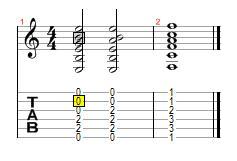
First thing, don’t worry that much about what’s the name of that new chord (though it’s advisable to eventually go through all those chords you’ll come up with and learn their name and function). Focus on how that sounds. Can you add some other note from that melody line instead of A? Let’s try a few of them:
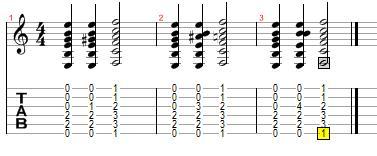
Not all added notes may sound melodic until you actually make a transition to F guitar barre chord. Now, try to add the notes on 1st melody line:
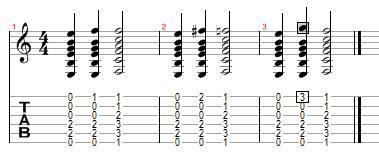 Notice which changes are more melodic than others. Which fit in which key.
Try doing this on all melody lines. Also, try adding notes on F chord. You can use lower or higher notes, of course.
For example:
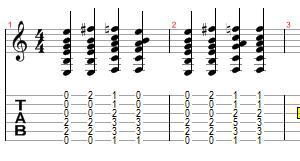
Another thing you can do is combine the melody line changes. For example, let’s change 2 melody lines simultaneously:
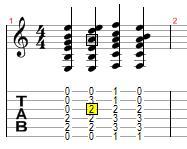 I’m sure that by now, you got lots of ideas going on. Apply this to all chord progressions you already know. Write out all those chords that seem melodic to you, and later on, learn their names. This approach is really good in songwriting, too. You would be surprised by how many melodic ideas you can get by changing only 1 melody line.
You can also transpose the chord octave higher. This gives you some new fingering options, you maybe didn’t have before. For example:
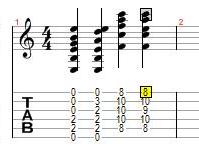 All of this, however, is only a small portion of what could be discussed through tons of pages, and it should act on you only as a push into this inspiration tomb. Enjoy!
A Must-Have Tool For Every Guitarist…

Guitar Pro 6 enables you to see and hear exactly how a piece of music is played. Besides a full-fledged library to help you identify chords and fingerings, you can easily learn new songs from tabs! I highly recommend a copy of the software to people who are serious about learning the guitar.
Click here to download Guitar Pro 6 instantly now…
Related Articles



We Recommend…

Leave A Comment