
Learn How to Play Major Scales – Fundamentals & Beyond
 The major scale can be considered the most important scale in music and forms the foundation on which other scales are constructed. From popular music heard on the radio to trash music, the major scale can be found at the core of all types of music.
Whether you realize it or not, I can guarantee that you had heard of the scale sometime in your life. That’s also partly the reason why I chose to kick off the series of lessons by introducing the concept of major scales first.
The Basics – C Major Scale
Let’s take a look at the C major scale which is by far the easiest to understand. The C major scale is comprised of the following notes: C D E F G A B C.

The major scale is often described as being upbeat and happy sounding.
Simple right? There are no sharps or flats in the C major scale and it is relatively straightforward. However, you might be wondering why the notes in C major are C D E F G A B C and why it doesn’t contain other random notes like D# F# G# Ab Bb C#?
Constructing The Major Scale
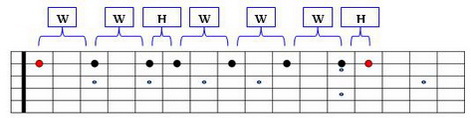
Well, the answer lies in a simple formula that is used to create any major scale: WWHWWWH. (W = Whole tone and H = Half/Semi-tone).
Let’s take a look at the illustration of how this works. We will start off by indicating the root note in red on the 2nd string. This is our starting note and when you apply the major chord formula to the fretboard, you will be able to derive all the notes of the C major scale.
The Formula Works For Any Other Notes Too!
Now, you can apply the same formula to any note to get the corresponding major scale. For example, if you were to take G as your root note now, the 2nd note of the scale would be an A note since it is a tone higher (W). The 3rd note is a tone higher (W) than the 2nd note and this gives us the B note.
Moving on, the 4th note is now a half-tone (H) higher than the 3rd which gives us the C note. And as you continue using the formula, you will finally end up with the notes: G A B C D E F# G for the G major scale.
Major Scale Exercise To Practice Your Fingerings
Here’s an exercise that’s based on the 1st position of the C major scale. This scale pattern is also known as three-notes-per-string and you get to play the entire scale while moving up and down the fretboard.
I want you to practice this exercise using alternate picking and a metronome set at a comfortable speed. This exercise will not only help you memorize the scale pattern, but it will also improve your finger coordination at the same time.

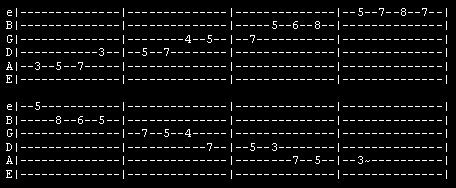
Download .gtp5 or .mp3 file ( Right-click Save Target as… )
Like the movable barre chords, the beauty of this scale pattern is that you use it on any starting note (e.g. 7th fret) on the 5th string. By doing so, you will instantly be playing the corresponding major scale based on its starting note (e.g. E major in this case).
In the next lesson, we are going to touch on the different scale patterns found across the fretboard. Stay tuned!
Jamplay – Awesome Teachers, Excellent Video instruction And Community

Jamplay is the LEADING online guitar lesson website that offers step-by-step videos in high-definition. They cover EVERY genre of guitar style and have comprehensive content for guitar players of any skill level.
Jamplay also showcases a continuously growing archive of instructional videos that’s updated weekly. What’s even better, they also offer indepth tutorials for members to learn popular songs with the help of precise, dynamic tabs and song demonstrations.
p.s: We’ve arranged a special deal for our readers. Get your exclusive Jamplay promotion code here…
Related Articles



We Recommend…

Leave A Comment
One Comment
I need to learn all of my scales, how to connect them, move from one to another, modes, arpeggios and how to speed them up!