
How to Play Natural Harmonics on Your Guitar
 Harmonics are defined as notes that are produced when a string is played in a way where vibrational overtones are created. They can also be formed as a result of amplification, or restriction of vibration.
Natural harmonics only occur on the guitar at certain positions of the string. They are formed when the string is played with no fretted notes.
Technical Explanation of How Harmonics Are Formed
The points on a guitar neck where natural harmonics occur are called nodes and are located on the 24th fret, the 12th fret, the 7th fret and the 5th fret. These are specific points on the string which remain stationary when the string is plucked and vibrating.
Now, when a guitar string is struck, the note you hear is actually made up of a number of tones. The note that you play, be it an open string or a fretted note, is known as the fundamental tone. The other tones are made up of different node points along the string and are called overtones. It is these overtones that are used to create natural harmonics on the guitar.
How Do You Actually Play Natural Harmonics?
In the first example, let’s play the harmonic on the 12th fret of the 6th string. To do so, you need to play an open E on the sixth string first. While the note is still ringing, gently touch the string right above the 12th fret with your finger.
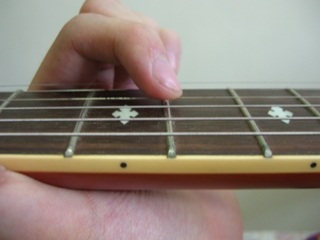
Right
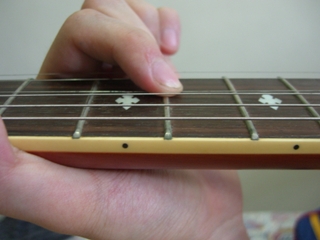
Wrong
The key here is to place your finger softly against the string and you should experiment with varying amounts of pressure to find the sweet spot. * Note that if you push down too hard, you might accidentally mute the string instead. Once the harmonic sounds out, remove your finger from the string and let it continue ringing.
An Overview of Natural Guitar Harmonics
Are produced using your fretting hand
Are played with an open string
Can be produced anywhere on the neck, but are easiest to produce in certain places
Are indicated in tab with brackets surrounding the fret number. For example: <12> or <7>.
Are indicated in Guitar Pro with a diamond symbol to the left of the fret number
Video Tutorial – How Natural Harmonics Are Played
A Beginner’s Exercise to Get You Familiarized
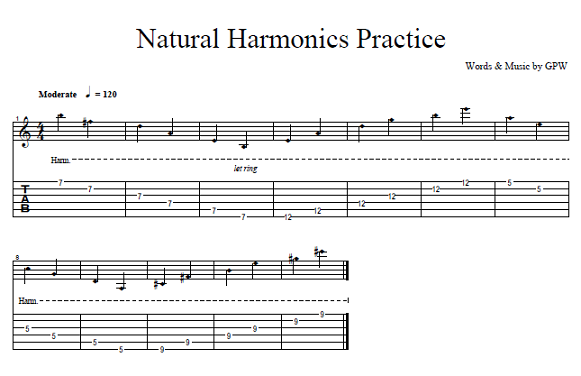 Download .gtp5 ( Right-click Save Target as... )
Learn Whenever And Wherever You Want…

Guitar Tricks is a MASSIVE online repository of more than 4,000 professionally recorded video guitar lessons. They also feature a core learning system that is specially designed to help guitarists of all levels progress in their skills.
Check out Guitar Tricks and get instant access with a 14-day trial today!
Related Articles



We Recommend…

Leave A Comment