
Understanding Rhythm Changes in Jazz Styles
 Every jazz guitarist knows this progression, and every jazz guitarist fears this progression. I Got Rhythm by George Gershwin is the basis for countless pieces. That being said, it is also one of the most difficult for some guitarists to improvise over because of its fast-paced feel.
Before you can learn to improvise over a piece, you have to understand what exactly is being played.
The basic rhythm change is a thirty-two chord progression made up of on AABA form. Because it is a swing progression, the pace seems almost relentlessly fast paced compared to most jazz.
Each section of the rhythm change is made up of eight measures. Each measure varies slightly with different chord choices, but the outline remains the same.
Before you approach the provided sample of a rhythm change, there are a few things you must go over.
First Off You Need A Steady Rhythm
If you frequently find yourself running past your time signature, or you find that your note values are always a bit uneven, then you should practice. Use a metronome at a low tempo and practice your note values. Not only are note values important in all music, but especially in techniques based on rhythms, such as rhythm changes.
If you constantly have trouble with note value and rhythm keeping after practicing with a metronome for a while then it is dire for you to focus all of your practice on rhythm and wait to approach any rhythm-related exercises or techniques until you feel comfortable with your progress.
Warming Up Before Playing
A very important thing to do, especially in jazz, is to warm up before you play. Jazz music uses a lot of large and complex guitar chords, and some of those large chords are widely spread. If you aren’t properly warmed up you can injure your wrists stretching your fingers out to achieve certain shapes. Make sure your hands are warm before playing; cold hands leads to stiffness and stiffness leads to injury.
Try running your hands under warm tap water for a few seconds, and then rub your fingers gently to help encourage your blood flow. Start off with a few simple scales or a few simple songs before approaching this exercise, as the chord shapes may be foreign to you, requiring more dexterity.
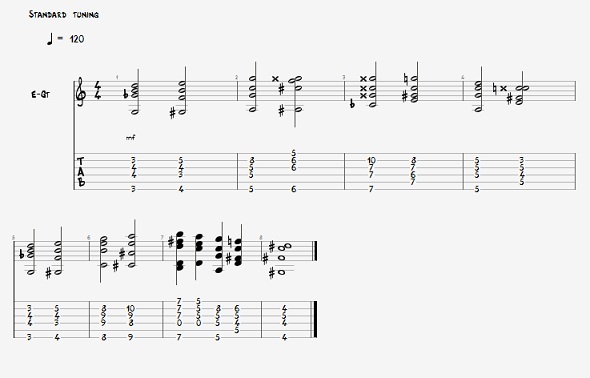
This example is using basic variations of George Gershwin’s I Got Rhythm. The chords are some of the most popular –and common– used within rhythm changes patterns.
Download the .gtp file for the lesson ( Right click and Save As… )
If you do not have GuitarPro yet, download a copy of Guitar Pro instantly here…
I took the basic guitar rhythm change and modernized it to allow you to improvise over it. Notice how there are only eight bars provided; this is because we want you to finish the rhythm change. Not only will this help you better understand it, but it will also help you better develop your own knack for rhythm changes.
Now that you see what chord qualities make up the first eight bars, it is your turn to change the rhythm qualities. One of the most popular techniques is to play the I7 and IV chords as whole notes for the last four measures, but there are no true boundaries so long as you stay within the context. Have fun!
Looking For Step-By-Step Video Guitar Lessons?
Trusted by 200,000+ students, Jamorama is the leading provider of guitar courses. If you are looking for a fun way to learn the guitar and want to play-along to your favorite songs, check out Jamorama today…

Are You Looking For Great Guitar Lessons For Children?

The Learn And Master Guitar Homeschool course contains step-by-step lessons designed to teach children how to play the guitar. With a carefully designed 2-year curriculum, this course is perfect for parents who want to homeschool their kids even if you don’t know how to play the guitar.
Related Articles



We Recommend…

Leave A Comment