
Guitar Tapping Techniques With Your Fingers
 When playing the guitar using normal hand positions for your fretting hand, you will be limited in note range when voicing a particular chord, or arpeggio.
The fact is that it is technically very challenging to play extra notes higher up the neck without losing your hand position altogether. Yet, relying solely on fretted notes limits your range and playing speed.
This is why guitar tapping techniques are essential to learning in order to advance from beginner to intermediate and beyond. Being able to accurately sound notes with either single- or double-handed tapping, will greatly increase the range of notes you can play at a given time, and even the kind of music you play on a guitar.
What Is Guitar Tapping Or Finger Tapping?
Guitar tapping is an extension of playing notes with hammer-ons and pull-offs. While hammer-ons and pull-offs usually require the string to be played as normal at some point, guitar tapping techniques can be executed without the need to strum or strike the strings at all.
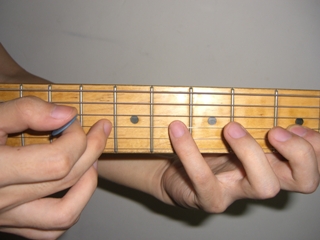
While holding on to the pick with the index finger and thumb, you can perform guitar tapping using your other “free” fingers. In the example above, I am using my middle finger to hammer the 10th fret of the G string and pulling off subsequently.
How to Tap Without A Pick In Hand
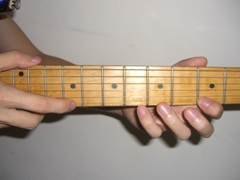
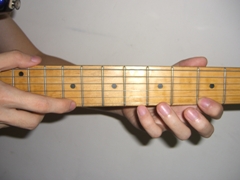
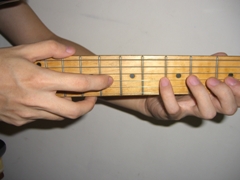
Alternatively, here’s how you can perform finger tapping without a pick in my hand. Notice how I grip the fretboard using my thumb and middle finger to provide additional support for the right hand?
Exercise to Train Your Fingers And Build Strength
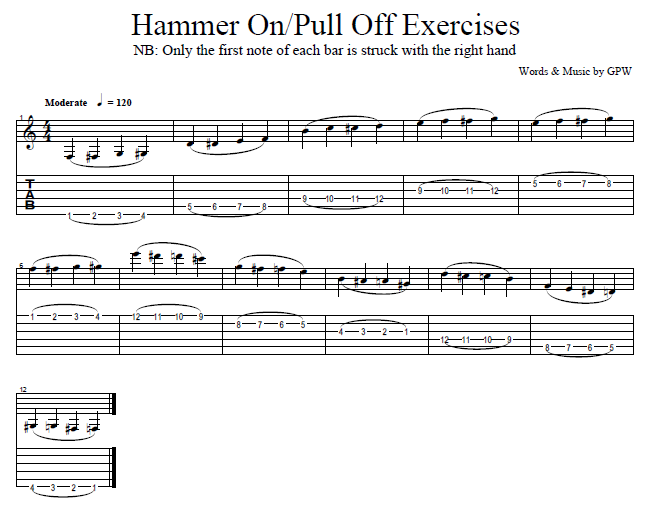
Download .gtp5 ( Right-click Save Target as… )
Most people don’t face significant problems when playing hammer-ons since it is relatively straightforward. On the other hand, pull-offs aren’t that easy to pull off (pun intended) and I want you to pay more attention to the second half of this exercise.
Although pull-offs utilize a similar technique as the hammer ons, they are played down the fret board, instead of up. That is, they move from a higher to a lower note and utilize a different set of muscles in your fingers.
To pull off with your left hand:
- Put your pinky, ring or middle finger on a note on the fret board
- Put your index finger on a note behind it on the same string
- Pull the higher finger away, making sure that you pull at the string to sound it off.
Taking It to the Next Level – Tapping With Your Fingers
Once you’ve practiced hammering on and pulling off for a while, you’ll realize that the two techniques are closely related and flow together. You can hammer onto a note, and immediately pull off back to the original one.
This is the basis of tapping. When you hammer on and pull off to the same two notes at extremely high speed, it is known musically as trilling.
To learn how to tap:
- Start off trilling two notes – for example, use the 5th and 8th frets on the B string. Do the trilling slowly, even if you’ve practiced enough to be quite quick.
- Once you have a rhythm going, use your right hand middle finger to hammer onto the 12th fret, after you’ve hammered onto the 8th.
- Pull off the 12th fret, and then continue to pull off the 8th fret as you would have.
- You’ve created a three-note trill – also known as tapping.
- Quadruplet trills are also possible. It is much easier to practice with three fingers of your left hand, and the middle finger of your right, rather than using two fingers on each hand.
Guitar Tapping Exercise Inspired By Van Halen
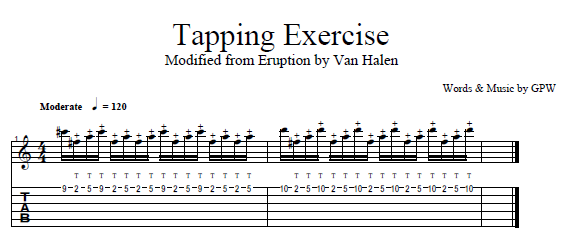
Download .gtp5 ( Right-click Save Target as… )
Even though the tablature for this tapping exercise may seem intimidating, it really isn’t. The things to watch out for is to stay in time and focus on your technique by practicing at a slower tempo first.
Double-Handed Guitar Tapping
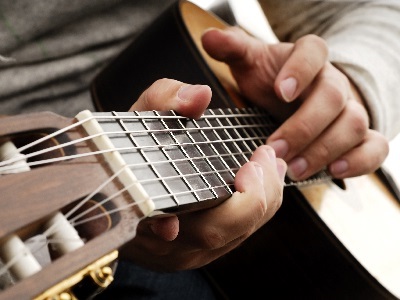 This technique involves using both your hands to tap notes on the fretboard and is used in scenarios where you need to play overlapping notes fast. If you had seen some of the guitar legends like Van Halen or Steve Vai play, it’s not unusual to see them executing an 8-finger tapping technique.
Guitarists using double-handed tapping are able to music that is normally reserved for pianos or keyboards, because they can accurately play eight or even nine separate notes, depending on their dexterity.
The effective note range is also increased. Double-handed tapping allows a guitarist to play two melodies, or a melody and accompaniment simultaneously, in the same way that a pianist can.
The left hand is used in the normal manner for fretting, while the right is positioned opposite the left on the fretboard, parallel to the frets. The effect is quite dramatic, due to the change in note layout for the right hand.
Tips to Better Finger Tapping
You will be using both hands in this technique so you should have a neck swing in the guitar for support. I highly recommend using new strings instead of playing with rusty strings as they may lead to cuts on your fingers.
For the guitar practice itself, do not overly press the chords onto the fret board as this would kill your playing speed. Remember that you also need vibrations for the sound to be produced. For a tightly wounded string, and a very intense grip, the tension will be enough to kill any vibration you intend to make. In that regard, strive to hit a certain balance.
Good Songs to Learn for Practicing Finger Tapping
- Thunderstruck, AC/DC
- Crazy Train, Ozzy Osbourne
- Hot for Teacher, Van Halen
- Midnight, Joe Satriani
- Building the Church, Steve Vai
That driving, ecstatic, climactic sound of properly executed tapping on a guitar has driven many a crowd to a screaming, writhing peak! Now, it’s time to pick up your guitar and practice. Who knows, someday you might be the one on stage wowing the crowds with your deft guitar playing skills.
Guitar Lessons Guaranteed to Help You See Massive Improvements!
Jamplay is the ULTIMATE online guitar lesson website that offers step-by-step videos in HD. They cover ALL genres of guitar styles and have comprehensive content for guitarists of any skill level.
Jamplay also features a growing library of video lessons that are updated weekly. Besides that, they also offer indepth tutorials for members to learn well known songs with the help of accurate, dynamic tablatures and song visualizations.
p.s: We’ve created a wonderful deal for our readers. Get your exclusive Jamplay discount code here…
Related Articles


We Recommend…

Leave A Comment