
Music Intervals And Basic Theory for Guitarists
 I want to do a quick introduction to some basic music theory in this tutorial. Basically, a music interval refers to the distance between 2 notes. Now, many students have asked me why they should even bother learning about music intervals when they could be spending their time practicing the guitar.
My answer is simple: music intervals are the building blocks of harmony. Without some basic prior knowledge of music intervals, you would find scales, chords and music progressions very difficult to comprehend.
Now, there are 2 types of music intervals; namely harmonic and melodic. Melodic intervals refer to playing 2 notes of the interval separately while harmonic intervals refer to playing 2 notes at the same time.
Basic Music Theory: Naming the Intervals
In order to name intervals, the lower note is always taken as the reference and the distance to the higher note is then counted (in terms of semi tones). Let’s say we are given 2 notes, C & D. In this case, the lower note ( C ) is taken as reference.
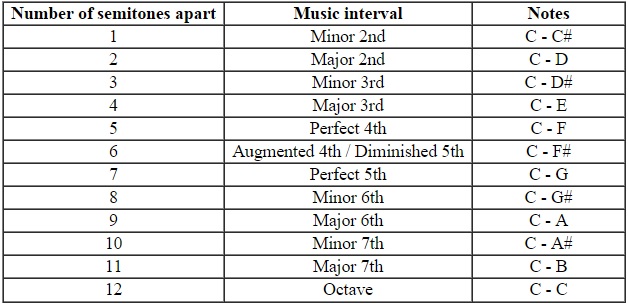
I have summarized all the music intervals into a table using C as the lower note.
To keep things simple, let’s use the C major scale to help reinforce some concepts.

On the guitar, C-D is 2 semi tones apart ( 2 frets apart ). Hence, the interval between C-D is a major 2nd.
On the guitar, C-G is 7 semitones apart ( 7 frets apart ). Hence, the interval between C-G is a perfect 5th.
Examples In Other Keys And Reference Notes
What happens if you have a D-G# interval? How would you name it now?
The answer is an Augmented 4th because they are six semitones apart. (D – D# – E – F – F# – G – G#)
Key Pointers to Note
- A major interval lowered by half a semitone – Minor interval
- A major interval raised by half a semitone – Augmented interval
- A minor interval lowered by half a semitone – Diminished interval
- A minor interval raised by half a semitone – Major interval
- A perfect interval lowered by half a semitone – Diminished interval
- A perfect interval raised by half a semitone – Augmented interval
Most beginners have some trouble with naming intervals due to enharmonic nomenclatures. This is because the same note pitch can be named differently.
For example, a Major 3rd interval can also be represented by a Diminished 4th interval (even though both refer to the same pitch!) depending on the context of the song and key signatures. As a beginner, you don’t have to worry too much about the musical jargon at this point.
To recap the lesson, I had shown you how the most common intervals used in music. If there’s one thing you need to take back, the table on interval nomenclature is really all you need to know.
The Ultimate Guitar Learning Guide

Related Articles



We Recommend…

Leave A Comment
One Comment
In the chart, the ‘notes’ for minor intervals are wrong.
Minor 2nd above C is Db (D flat)
Minor 3rd above C is Eb
Minor 6th above C is Ab
Minor 7th above C is Bb
C – C# is known as a ‘false relation’
C – D# is an ‘augmented 2nd’ which, for example, can be heard at the end of the harmonic minor scale