
Shapes of the Major Scale and Movable Scale Patterns
 One of the best things about playing the guitar is the ability to move shapes (e.g. barre chords, power chords, scales) and patterns around the neck with ease.
Movable shapes and scale patterns can allow you to play in any key by applying the same fingering pattern to a different root note. This means you can easily transpose between musical keys without too much difficulty.
C Major Scale Denoted In The Entire Fretboard
To recap, you will find the following notes in the key of C major:

Let’s take a look at the note locations of C major scale across the entire fretboard. The root notes have been denoted by red circles.

Are you intimidated by the massive diagram and the prospect of memorizing it? Luckily for you, there’s a better way to go about doing this by breaking it up into smaller chunks.
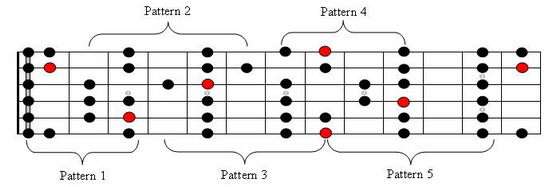
Basically, the positioning of major scale notes can be divided into 5 main patterns on the fretboard. The reasons for dividing them like this to achieve efficient fingerings as well as to facilitate learning.
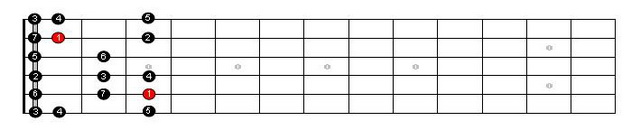
Major Scale Pattern 1
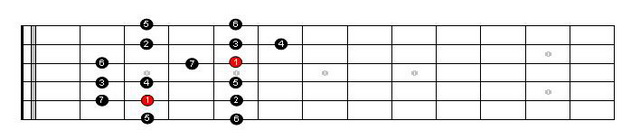
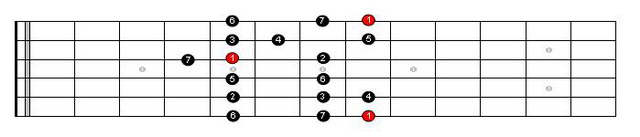
For your convenience, I included the scale degrees into the 5 patterns to help you better visualize what you are playing.
Major Scale Pattern 2
Major Scale Pattern 3
Major Scale Pattern 4
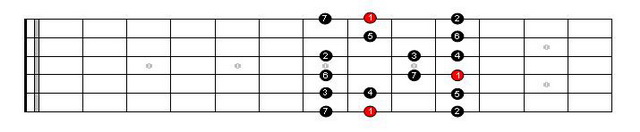
Major Scale Pattern 5
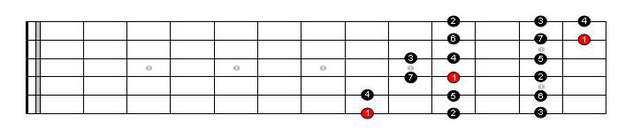 For a start, you should begin by committing patterns 1, 4 and 5 to your memory. The end goal is to fully memorize all of the 5 scale patterns as they come in handy during improvisation and soloing.
How to Transpose Scale Patterns to Other Keys
The beauty of learning the various fingerings is that you can easily improvise or transpose your playing to any key you want. The trick to doing this is to use the root note as a guide to transposing.
Let’s use Pattern 1 as an example to illustrate this and imagine that you want to play in the key of G major. Now, I’m sure you already know that the 1st note in G major starts with a G note.
Using the root note (red circle) as a guide, locate the G note along the 5th string and shift the entire pattern along the fretboard such that the root note starts at G note.
Transposing to G Major key
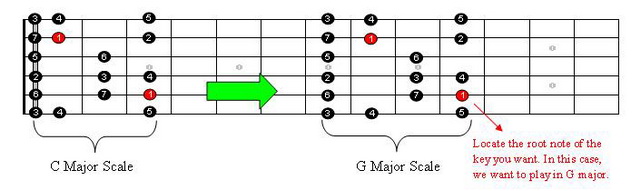
That’s all to it for transposing to different keys. Simple? The scale patterns remain the same except that the pattern is located at a different fret.
Transposing to F Major key
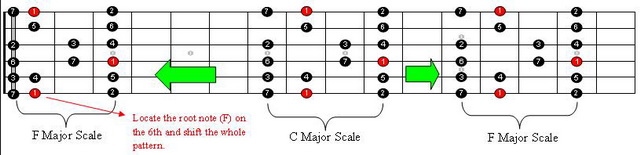
Below is another example of transposing Pattern 4 to F major. The point I want to bring across here is that you can move the pattern up or down the fretboard as long as the root note (red circle) begins with an F note.
A Quick Practice Exercises And More Tips
Spending time to learn the scales is all for naught if you don’t practice or make use of them in your playing. Here’s a simple chord progression in C major where you can experiment around with your new found knowledge.
Download .gtp5 or .mp3 file ( Right-click Save Target as… )
Try to make use of the various scale patterns and jam along to the backing track. Have fun and let me know what you can come up with!
Revolutionize The Way You Play And Learn Music

Guitar Pro 6 is a powerful tablature editor software for guitar, bass, and other fretted instruments. Equipped with a realistic audio engine, it makes writing music, guitar playing and learning songs a walk in the park. Click here to download Guitar Pro 6 instantly now…
Related Articles



We Recommend…

Leave A Comment